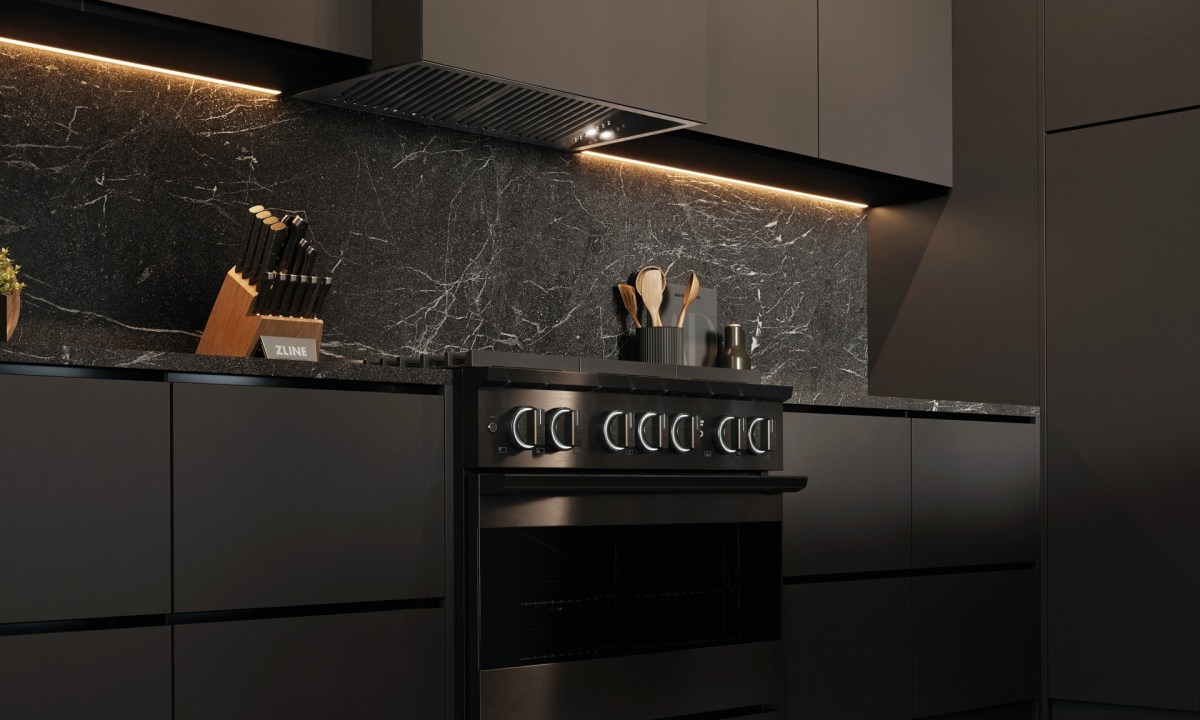
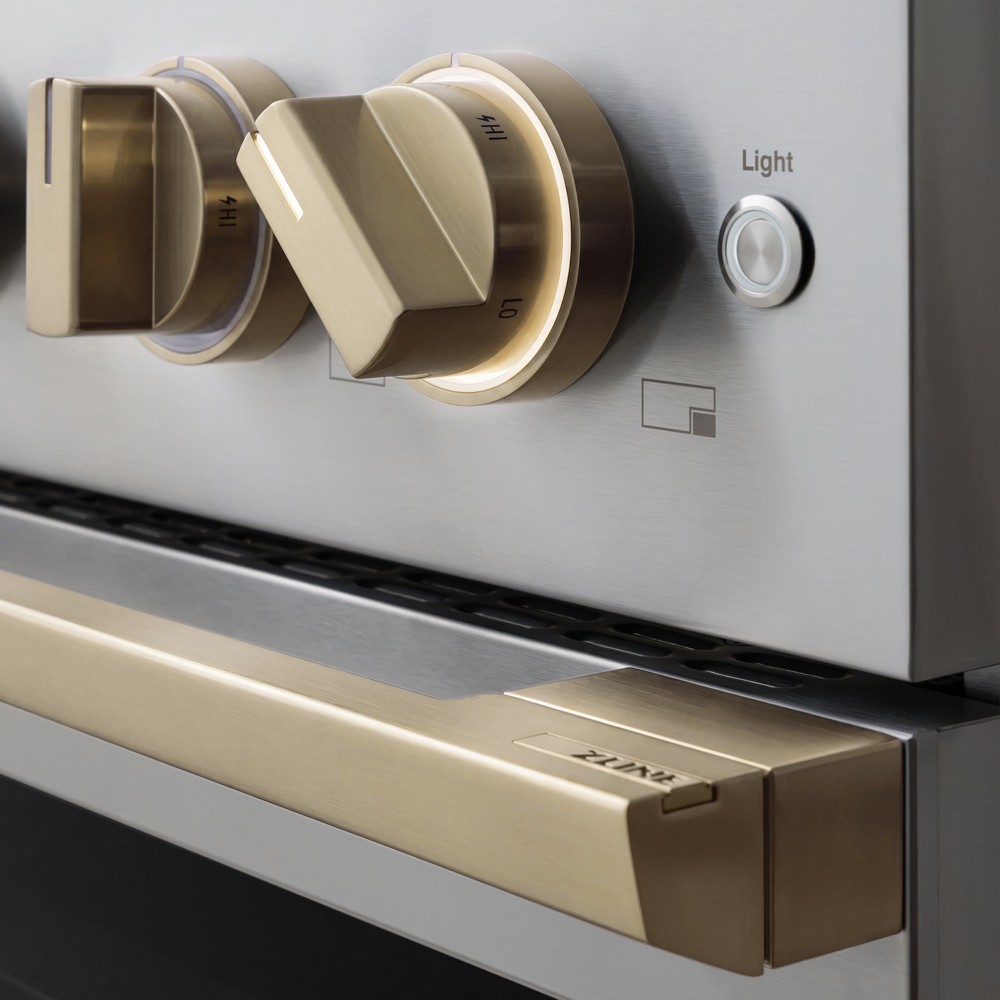
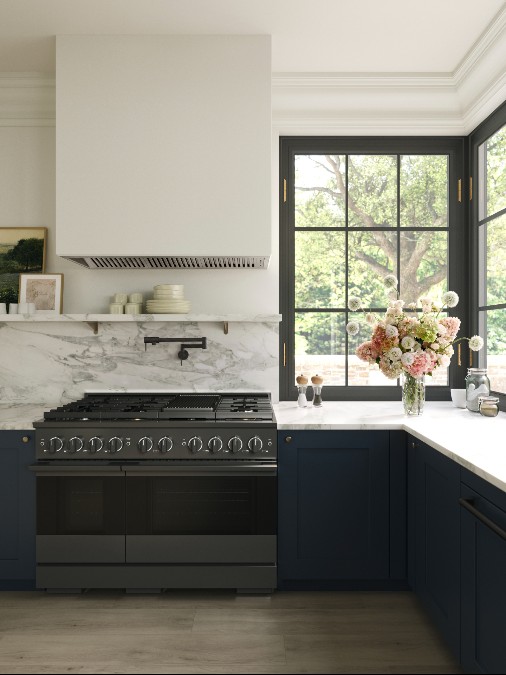
The seven knobs are neatly spaced, their LEDs growing in intensity as they turn, and a seamless glass surface offers a clear view of what’s ahead. A handle designed around human anatomy naturally falls into the hand, like a door latch clicking into place. The stainless steel surfaces’ metallic sheen contrasts with the glass, creating a mood of sleek elegance.
That might sound like sitting inside a Porsche 911. But it’s automotive-influenced detailing of ZLINE’s newest range collection, Marino, created by Moritz “Moe” Merkert, Director of Design. I spoke with Moe about growing up in Germany, surrounded by a family of fine cabinet makers, his love of Porsche, and how both shaped the decisions behind the Marino range.
Raised among craftsmen
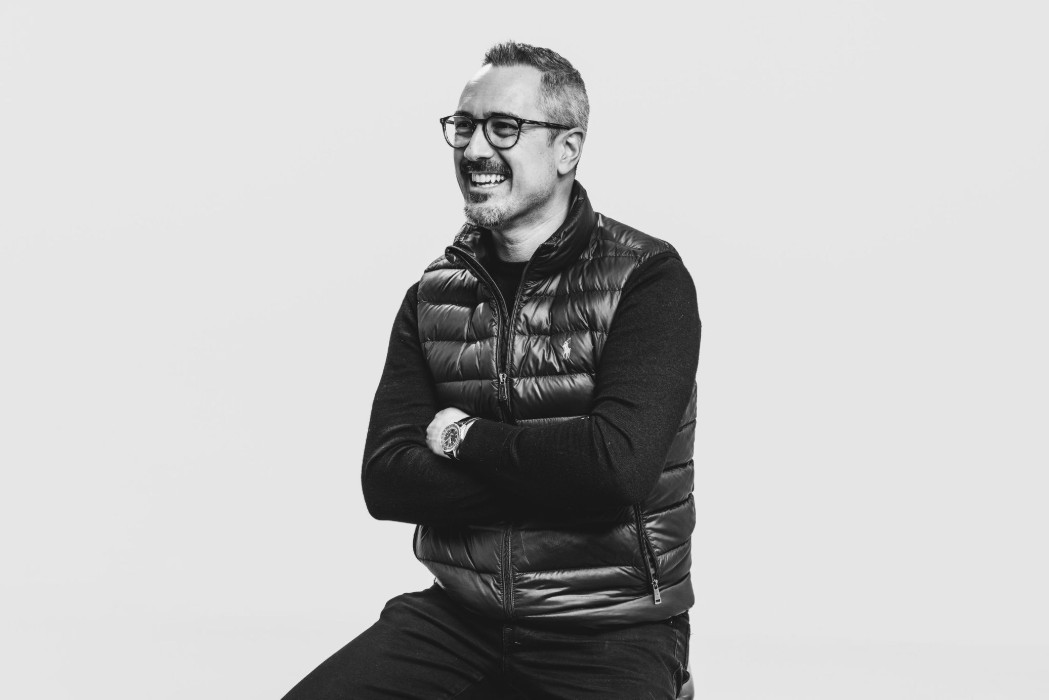
Merkert grew up in Baden-Württemberg, between Frankfurt and Stuttgart, about an hour from Porsche headquarters. A lifelong automotive enthusiast, with particular affinity for the 911, he describes the influence of cars on his design thinking:
“Think about a luxury car—every single component is purpose-built. Nothing is there by accident, and nothing is redundant. The engineers aren’t adding features for the sake of it; every material choice, every line, every detail exists because it serves a function or elevates the experience.”
He grew up in a family of craftsmen: his uncle owned real-Innenausbau, General Contracting and Shop-Fitting, and his cousin ran Pedde Innenausbau, Master Cabinet Maker.
In the ZLINE Marino Collection, Moe’s background shines through in the perfect joints, organized controls, and bullnose-style handle.
The Design Thinking Behind Marino
The Manual: Could you tell me how you got into industrial design?
Moritz Merkert: I’m a product designer, actually. So I am from Germany, so there are a few different types of product design slash industrial designers. They handle it a little differently. But my background comes from my family. There are five or six cabinet makers and master cabinet makers in my family, and pretty much that’s where I started to show some interest in just building things.
When I started my journey, I worked for my cousin as a cabinet maker, and he pretty much showed me the ropes. And since then, I’ve been interested in the product world or the interior world. So I’ve worked for many years in the retail outfitting and hotel and restaurant business. And in Europe, we’ve had some of the largest brands, from clothing to sunglasses to just luxury products. We had customers, and we would do their stores and hotels or restaurants.
TM: It sounds like that would really instill a sense of taste for design and materials.
MM: I believe so, yeah. And in proportion, yes.
TM: Now, I was reading about you, and it said you had a lot of influences in architecture. Can you cite any buildings or particular architects that influenced you?
MM: I do enjoy and I appreciate architecture. For me, it’s a feeling, to be honest. So it doesn’t necessarily have to be a certain style or a certain era.
TM: I understand you have an interest in cars and motorsports. Are there any particular car designs or race series that you’re particularly passionate about?
MM: So GT racing, and especially endurance racing, is for me the most desirable, or what I enjoy most. I occasionally watch some Formula One. Clearly, this is the biggest platform when it comes to racing in the world.
But GT racing, especially endurance racing, is what I enjoy the most. I mean, I was born in Germany. I am from Germany. I’m a big Porsche fan. You know, I grew up just about close to an hour away from Zuffenhausen, from Porsche. And from early on, I had contact with Porsche.
TM: So getting into your design on this Marino collection, I saw where you said you were talking about the philosophy where nothing is an accident, you know, everything’s intentional. Could you talk about some examples in the Marino that illustrate that?
MM: For me, the approach to design is that everything has to be intentional. And what I mean by that is it’s just no fluff, no unnecessary items or features that will add no value to the experience of a customer. I try to apply this logic, or this philosophy, to pretty much everything I do, just because I believe in the experience. So if I draw the line to motorsports, and you know it as well, in motorsport, there’s nothing unnecessary.
So when we look at the Marino range, when we look at the Marino series, I wanted to create an experience for the customer where, as soon as they interact with the range, everything is clear. Yes, other brands have lights in their knobs, but we haven’t had that. So it was my desire to have the interaction with the customer and the product to have clear distinction and clear signals.
So when you use one of the burners, for instance, the lights will light up, and they’re going to be on a standby light, pretty much on it, like a dimmer tone. And when you turn it on, so when you interact with your product, that one particular ring then will light up, and it tells you that it’s active, that it’s working and it’s being used. So when you walk by, you know exactly which burner is on, which part of the cooktop is active. So these are small things that you can relate to or translate to, I guess, purposeful design.
TM: Now, could you point out one detail on some of these designs that has especially strong automotive influence?
MM: I would probably consider the handle being something that is a little bit more, even more intentional, I would say. For me, it was important to have a great feel when you touch it. Yes, it might be a stretch when I say, just like you would hold a steering wheel. But if, let’s say, a car enthusiast has been in a certain vehicle, in a certain car, and they know how certain things feel, how a steering wheel feels, how a gear shifter feels, and it truly fits perfectly in your hand, that’s what I was trying to get to when it comes to the handle.
Often in these types of products, in these types of consumer products, you use stock material. It’s a tube, and then you create a handle bracket that is then connected to the door. And my intention for the handle was to truly have an experience. So when you hold it, you can feel it, how it perfectly sits in your hand, and it’s your hand and your finger shape around that handlebar.
TM: What would you say is the overall personality of this design?
MM: I think I’ve heard some people talk about minimalism. But if I were to word it, I would say intentional modern.I would say that it’s something that we, so with Marino, we at ZLINE, we have the opportunity to pretty much bridge a gap in our product portfolio. We have been heavily leaning into more of a classic aesthetic, right? More like the professional range type of style.
But with, you know, with continuously emerging design, I believe I want to create a product that is still important, let’s say, in five years. don’t want a product that is just going with a trend. I want to have a product that is relevant in years to come.
MR: Now I’m seeing here where you mentioned the word user experience, and you said, we didn’t pull the stock materials, we didn’t just use stock materials or existing tooling; we shaped them specifically around user experience. Could you talk more about that?
MM: Yes, that’s what I was referring to when it comes to the handle specifically. With previous models, with other products on the market, you tend to work with the manufacturing capabilities that are at your disposal. And by that, I mean, for instance, you know, a handle, the easiest shape is a round handle. So you can then pull, more or less, from stock material. You create a handle bracket that pretty much holds the handle in place. You mount it to a door, and you pretty much have somewhat of a door assembly.
And for me, it was important that the few touch points that you have, where you interact with a product like a range, that these are intentional. And by that, I mean, okay, let’s think, you know, let’s sit down. Let’s try different handle geometries. Let’s see what feels the most, what’s the best tactile experience.
MR: I’m so intrigued by your background with your relatives being cabinet makers. Could you tell me just a little bit more about that and how that influenced you?
MM: Well, I guess, being around your dad, your cousins, your uncles, then being either a cabinet maker or in the cabinet industry, you are more or less in this world, right? You’re getting exposed to either being at the shop or being on a construction site, seeing how things are built. I think that sparked, at least for me, that sparked interest in how things are made.
You get your first touch points. You get to work with it. You get to work with tools. You get introduced into tools, you know, as a kid or so. And then you start building your first thing with some imagination, but you just don’t know how things come together, right? You might know how to use a few hand tools, and you use your experience in putting things together.
But the older you get, or the more you grow, you know, as a young kid, you’re interested in many things, right? I believe being exposed to, you know, this world, I’d say it’s started to create more interest in what else is there. And could I do that too?
MR: So on the Marino collection, what’s a detail that people might not notice, but that really shows that every detail matters?
MM: The badge. In our previous design series, we were somewhat bold, but we were always drawn to the professional style ranges, with a distinct badge that was on the door, that was quite visible in the center. You could say it’s part of the identity.
For Marino, I wanted to try something different, because I do appreciate craftsmanship, and one thing, for instance, one thing that I like are watches. So there’s a ton of craftsmanship, and really fine craftsmanship, in order to work precise.
So I had the idea of changing the location of the badge to not have it on the door, but integrated in some shape or form. So I played around with having it potentially on the bullnose. Bullnose doesn’t really make that much sense, because if you have it on the top of the bullnose, meaning on the top of the surface, it will just get dirty. You will going to have a hard time cleaning it. So we just played around with different locations, and we ended up having an embedded emblem in the handle itself. And that also being our distinct and signature finish, which is the champagne bronze finish.
MR: I’m looking at it right now, and man, it’s beautiful. It reminds me a little bit of an Audi interior, the switchgear.
MM: I love for you to have that spark of an idea going from there to a car. I do appreciate good car interiors as well. This is truly something where great geometry comes together, where a manufacturer works perfectly aligned with different types of materials. You use different, potentially you use different fabrics, different plastics, different coatings. Yeah, this is great that you mentioned this.
MR: So, Marino, it’s been described as where ZLINE design is headed. Can you tell me what comes next and what people should look for?
MM: Well, I can’t talk about what’s coming next, clearly, ’cause there’s, you know, many things in development. But what we meant with that is, we feel comfortable and strong in the current market that we’re in, and the, let’s say, the current design market, meaning the interior.
But Marino is for us a new chapter, and also a entry into the new market, meaning the ever-evolving design aspect. So that being said, there’s more to come for this market, for a more modern market, for customers that are, you know, enjoying the quality and the experience that they get with ZLINE, but with a modern or a contemporary aesthetic that they could then, you know, add on into their new kitchen or in their remodel.
So yeah, we’ve had customers that went through multiple series of products with us. So if this particular customer, you know, tends to plan another kitchen remodel, but they want something more up to date from an aesthetic perspective, Marino will be perfect.
From the 911 to the Kitchen
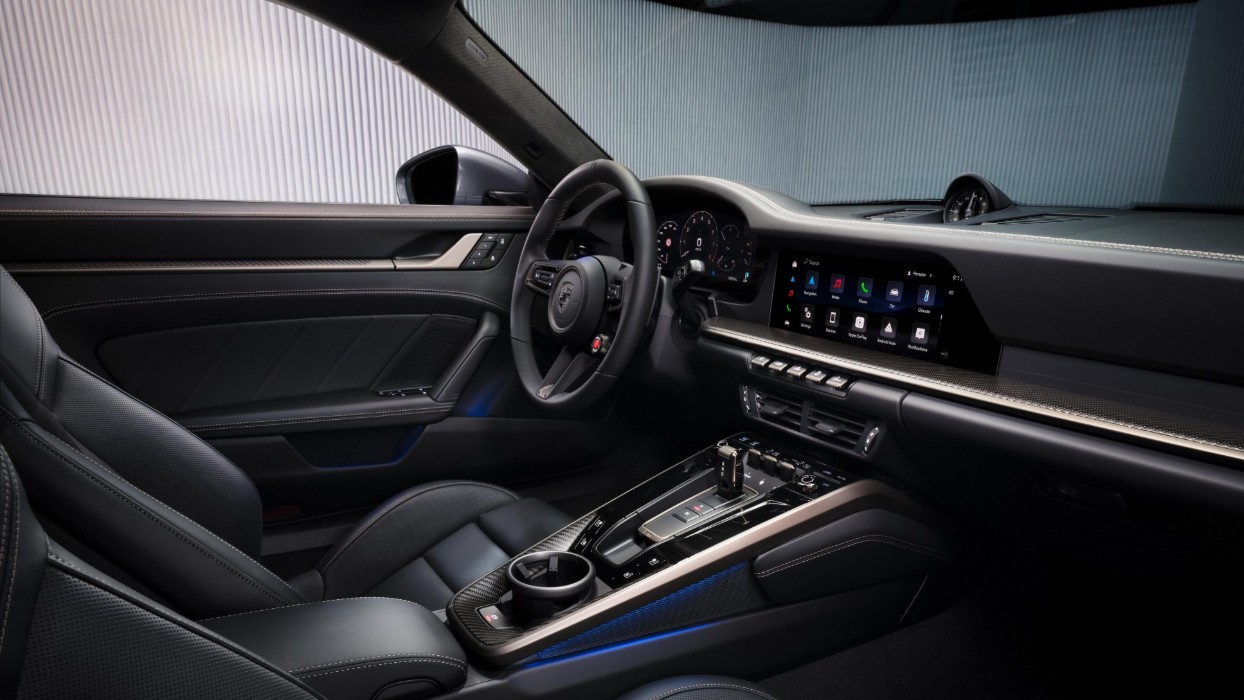
To end the interview, I asked Moe his favorite Porsche models: one race car, one road car.
“Race car, 917 KH, which is an absolutely iconic vehicle. I mean, 917 is, and I personally get to see it drive, and get to hear it. And it was beautiful. And if I were to go for a road or street car, my favorite shape of 911, or my favorite model of a 911, would be a 993.”
“And I had the chance to drive the 992.1 GT3 RS. And for me, I can’t describe how good that car is. I had the chance to be a passenger with a professional driver, and then I was also driving it for a day at the track, and it was the best thing I’ve ever done.
It’s unreal. That car is so good. Every time you get in a 911, you think they can’t make this thing better.”
The more one looks at the Marino range, the more the automotive influence becomes apparent, which Moe summed up:
“There’s definitely an automotive quality to Marino, particularly in the way the controls, materials and proportions work together to create a really seamless cooking experience. When you use Marino, it should evoke the same feeling you get when you sit inside a beautifully designed car, where everything feels expertly considered and has a clear function.”
“We’re not adding features just for the sake of having more. The angled handle, for example, isn’t just there to look more modern. It fits naturally in your hand while also giving Marino a more sculptural, architectural feel than a traditional range. The deeply tinted, full-front glass and illuminated controls create contrast and clarity without adding visual clutter. Achieving this minimalist design is actually more technically complex than it appears, but the goal was to make that engineering disappear, so what you’re left with is a range that feels sharp and effortless.”