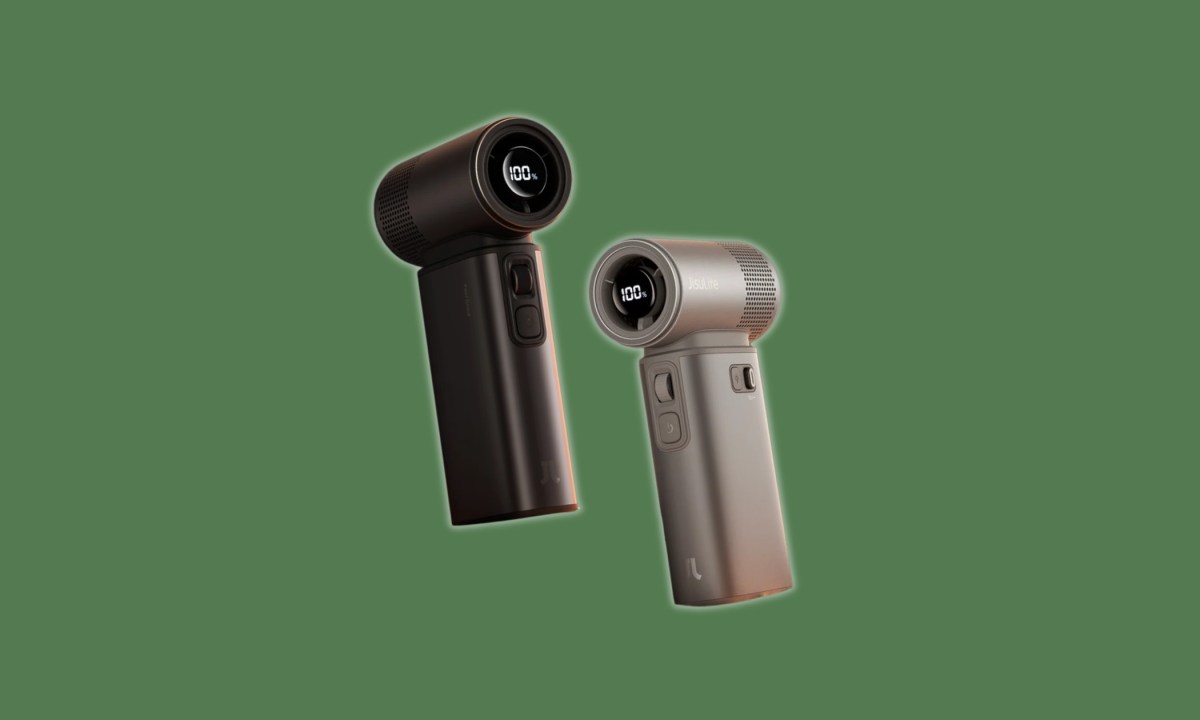
This article was produced in paid partnership with JisuLife. Testing and editorial opinions are presented by the author.
There’s a particular kind of misery that anyone who’s tried to survive a real heatwave with a pocket fan knows well. You buy the cute little thing, you switch it on expecting relief, and what you get is a polite breeze that runs out of battery somewhere between the subway platform and the office. I’d written off handheld fans entirely, filed under “gadgets that photograph better than they work,” which is exactly why I wanted to do this properly. So I bought two units, the Dyson HushJet™ Mini Cool fan and the JisuLife Ultra2, and ran them side by side through an honestly brutal summer to see whether either one was worth carrying. One of them made me rethink what this whole category was capable of.
Testing them the same way, on the same days
I didn’t want to rely on impressions alone, so I ran both fans through the same cooling test under identical conditions. At 36°C and 60% humidity, I timed how long each took to bring a surface down from 36°C to 30°C. The Ultra2 did it in about 5 seconds. The Dyson took 13. That gap isn’t subtle when you’re the surface in question. Point the Ultra2 at the back of your neck after a hot walk, and the relief is close to instant, whereas the Dyson leaves you standing there for a beat, waiting for it to catch up.
The airflow gap
That speed comes down to raw airflow, and it’s where the Ultra2 pulls clearly ahead. It moves air at up to 16.8 m/s, well past Dyson’s 14.9 m/s. If that number doesn’t mean anything to you, it didn’t to me either until I put it in terms I could feel: the Ultra2’s output is roughly a car moving through a city street at about 60 km/h, aimed right at your face, while the Dyson lands closer to 54 km/h. That advantage is exactly what you feel in sticky, motionless afternoon heat. The Dyson gives you air that drapes over you. The Ultra2 gives you air that actually cuts through, and it’s why it cooled me down faster every single time I ran the two back-to-back.
The battery is where it stopped being a fair fight
What sold me for daily life, though, wasn’t any single measurement. It was that I stopped thinking about charging entirely. JisuLife rates the Ultra2 at up to 24 hours on its lowest speed setting off a 9000mAh cell, while Dyson rates the HushJet at up to 6.86 hours. The two brands measure runtime their own way, so I treated those as the manufacturer figures rather than as test results I ran myself, but in practice, living with both fans, the difference was every bit as wide as the ratings suggest.
The way it played out over a week is more telling than the raw hours. I use a fan maybe five hours across a normal hot day, some on the commute, some at my desk, some on an evening walk. At that rate, the Ultra2 went close to five days between charges. The Dyson, used the same way, was dead in about a day and a half. One of those fans I charged on Sunday and forgot about. The other became a small daily chore, another cable to find, another thing to remember before leaving the house.
And then there’s the thing the Ultra2 does that the Dyson simply can’t: it charges my other devices. That big 9000mAh battery isn’t just for the fan. The Type-C port supports bidirectional charging at 18W, so the same unit that cooled me down all afternoon also served as the power bank that revived my phone on the train home more than once. There’s a real freedom in realizing the fan in your bag is also a backup battery, and it’s the moment the Ultra2 stopped feeling like a fan I was carrying and started feeling like a tool I relied on. Charging it back up, when it finally needed it, was quick enough that I never once got caught out.
The nozzles are the part nobody tells you about
Here’s what surprised me most, and it’s the thing that keeps the Ultra2 on my desk long after the heatwave broke. It isn’t really a fan. It’s a little air tool with magnetic nozzles that snap on and change what it does entirely.
The narrow nozzle turns the airflow into a focused jet, and I’ve genuinely stopped reaching for canned air. It blasts crumbs and dust out of my keyboard in seconds, clears lint from laptop vents, and gets into the corners of my camera bag. If you’ve ever paid for a can of compressed air that lasts three uses, a fan that does the same job on a rechargeable battery is a quietly excellent trade.
It earned its place outdoors, too. On a camping trip, it went from cooling the tent, to inflating an air mattress through the inflator nozzle, to nudging a stubborn campfire to life when the kindling wouldn’t catch. Add the built-in lighting with an SOS mode, and it starts to feel less like a summer gadget and more like something that belongs in the bag year-round. The Dyson, for all its polish, is a fan and only a fan.
The small stuff it gets right
A few details made the day-to-day nicer in ways I didn’t expect. There’s a proper LED display for battery and wind speed, so I never had to guess how much I had left. The roller dial offers 100 speed levels instead of the usual three, which may sound excessive until you find the exact setting that cools you without blowing your hair around. The aluminum body feels like it can take being thrown in a bag every day. There’s a safety lock so it doesn’t fire up on its own in transit, a honeycomb front that keeps long hair from getting pulled in, and a rear cover that pops off for cleaning. None of these are headline features. Together, they’re the difference between a novelty and a tool you actually keep using.
The bottom line
JisuLife is the world’s leading handheld mini-fan brand, and it’s easy to see why. The Ultra2 is a premium, high-performance machine that I ran head-to-head against Dyson’s flagship and watched out-cool it on the measurements that matter when you’re standing in the sun. Judged the way a handheld fan should be judged, on how well and how long it moves air, this was simply the more capable machine. The Dyson went back into a drawer. The Ultra2 is still in my bag.